Ally Financial Trades Above Morningstar's Fair Value as a 23% One-Year Rally Raises Overvaluation Concerns
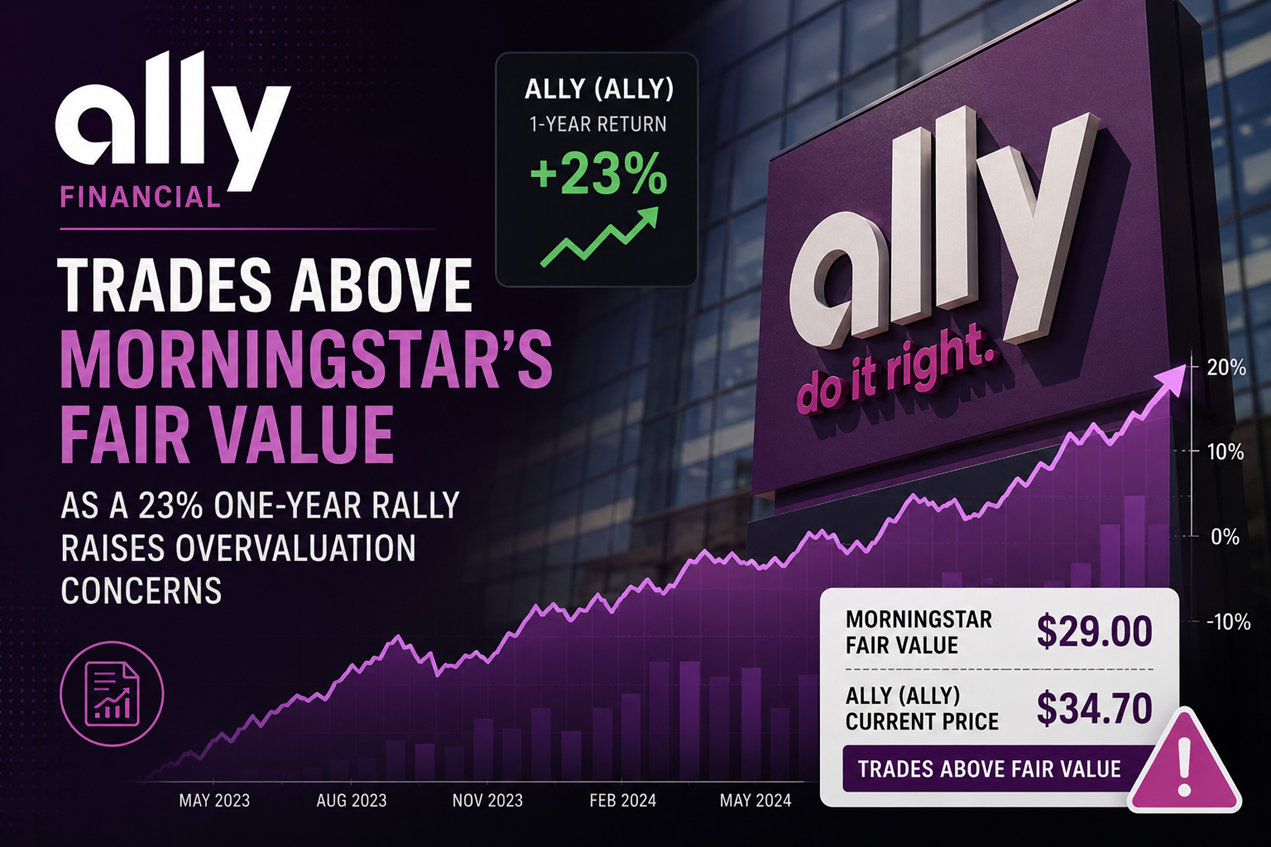
Ally Financial Trades Above Morningstar's Fair Value as a 23% One-Year Rally Raises Overvaluation ConcernsAlly Financial has staged an impressive comeback over the past year, with shares climbing sharply to sit near the top of their 52-week range [1]. But as the stock approaches levels that at least one major research firm considers well above intrinsic value, investors face a pointed question: has the market gotten ahead of the fundamentals, or does the rally reflect a genuine and durable business inflection?The Rally in Numbers: How Far ALLY Has RunThe numbers tell a story of accelerating momentum. Over the past year, ALLY shares have gained 23.15%, outpacing the broader market over the same period [1]. The stock's 52-week range spans $35.92 to $47.27, and as of mid-June 2026 it was trading near the upper end of that band — a positioning that historically signals either strong conviction or stretched sentiment [1].Near-term momentum has been particularly striking. ALLY posted a three-month gain of 18.37% and a one-month gain of 7.41%, suggesting that buying interest was accelerating heading into the summer [1]. The company carries a market capitalization of $13.94 billion with 306.52 million shares outstanding and a beta of 1.40 [1] — meaning the stock amplifies broader market moves in both directions, a characteristic worth keeping in mind as macro uncertainty persists.One important caveat tempers the enthusiasm: over five years, ALLY has significantly underperformed the broader market, a reminder that the current rally represents a recovery from cyclically depressed lows rather than a record of sustained long-term outperformance [1].The Valuation Disconnect: Morningstar's Fair Value vs. Wall Street's OptimismThe central tension in the ALLY investment case is a striking divergence between independent research and sell-side optimism. As of June 18, 2026, Morningstar analyst Michael Miller, CFA listed a fair value estimate of $17.80 against a current price of $45.49 — implying the stock trades at a substantial premium to that intrinsic value assessment [3]. The Morningstar analysis is titled "We Expect Improved Results From Ally as It Moves Past Challenging Conditions," suggesting the firm acknowledges operational progress while still viewing the current price as disconnected from long-term fundamentals [3].An independent signal corroborates the caution. GuruFocus flagged ALLY as overvalued on May 20, 2026, assigning a GF Score of 73/100 even as shares rose sharply that session — reinforcing the view that price momentum has outrun fundamental value [1].Wall Street analysts, by contrast, remain considerably more constructive. Analyst sentiment has improved following strong quarterly results, with some firms revising price targets meaningfully upward. The stock carries a trailing P/E of 11.09 and earnings per share of $4.10 [1], while a dividend yield of 2.64% with a quarterly dividend of $0.30 provides some income cushion [1]. On the surface, these multiples appear modest — but Morningstar's sharp fair value assessment suggests its analysts see structural or cyclical headwinds not fully reflected in consensus thinking [3].Q1 2026 Results and Business Fundamentals Driving the RallyThe rally has not been built on air. Ally reported a strong first quarter in 2026, with shares rising after the company logged record consumer loan applications [5] and delivered results that beat expectations on both the top and bottom lines. The Detroit-based firm's insurance segment was a particular standout, with written premiums reaching a first-quarter record and core pre-tax income rising sharply year-over-year, aided by lower weather-related losses compared to the prior year [5].CEO Michael Rhodes highlighted insurance as a critical lever for dealer relationships, with the Auto Finance and Insurance teams working to deepen what management described as an "all-in value proposition" for dealer partners. The broader strategic pivot — which Ally describes as "Focused. Forward" — involves exiting ancillary lending categories such as credit cards and residential mortgages to concentrate on retail auto lending and corporate finance, a move that appears to be gaining traction with investors.On a full-year basis, Ally's revenue reached nearly $7.9 billion in fiscal year 2025, while net income came in at approximately $852 million, producing a net margin of close to 7.0% — an improvement over the roughly 4.1% net margin reported the prior year [4]. That margin expansion, even against a backdrop of modest revenue contraction, is a key part of the bull case.A meaningful risk, however, is customer concentration. General Motors dealers accounted for roughly 34% of inventory financing and 24% of consumer automotive financing in 2025 [4]. That dependence on GM and Stellantis is a double-edged sword: it provides scale and established relationships, but it also means Ally's performance is materially tied to the fortunes of two specific automakers [4].Regulatory Headwinds and Insider Activity Add CautionBeyond valuation, several cautionary signals deserve attention. In March 2026, the SEC penalized Ally Financial for failing to disclose that it profits from "cash-enhanced" robo-advisory accounts — a compliance and reputational risk that could weigh on the company's digital banking ambitions [1]. For a firm that has positioned itself as the largest all-digital direct bank in the U.S., trust and transparency are foundational assets.Insider activity has also drawn scrutiny. A GuruFocus report from May 19, 2026 noted that executive Stephanie Richard sold shares of ALLY — a signal that the firm flagged as noteworthy given the stock's elevated price level [1]. While a single insider transaction rarely tells a definitive story, it adds to a mosaic of caution signals at current valuations.Short interest stands at 12.19 million shares, representing 4.01% of the public float as of late May 2026 [1]. That is a moderate but non-trivial bearish position, reflecting some institutional skepticism about whether the rally can be sustained.Peer Comparison and Outlook: Is There Room Left to Run?Relative to peers, Ally's valuation looks broadly reasonable in isolation but less compelling when profitability metrics are layered in. The company's P/E ratio of 11.09 [1] is in a similar range to other consumer finance names, and its 2.64% dividend yield [1] compares favorably for income-oriented investors. However, Ally's return on assets and return on equity trail those of peers like Capital One and Bread Financial, raising questions about whether any valuation premium is justified [3].The 2.8% annual dividend yield cited by The Motley Fool [4] and the forward earnings trajectory offer some downside cushion, but the wide gap between Morningstar's intrinsic value estimate and the current market price is difficult to dismiss. Morningstar's current fair value of $17.80 [3] represents a dramatic reassessment from the firm's earlier, more favorable view — implying that its analysts now see Ally's long-term normalized profitability in a substantially different light, even as the company exits lower-return businesses to sharpen its focus.The key swing factor remains credit quality. Five consecutive quarters of year-over-year improvement in retail auto net charge-offs [5] represent genuine progress, and management has reaffirmed full-year guidance [5]. But macro conditions remain uncertain, and Ally itself has described the environment as "dynamic," citing oil price volatility and shifting consumer sentiment as variables worth watching [5].For investors, the current setup demands discipline. The easy money from the deep-value recovery trade — when Ally was trading well below what even cautious analysts considered fair value — has likely already been made. New buyers at current prices are effectively paying for a successful execution of the "Focused. Forward" strategy: a bet supported by recent operational data [4][5], but not yet fully de-risked given the regulatory overhang [1], the concentration risk in GM and Stellantis [4], and the stark warning embedded in Morningstar's revised fair value [3].Upcoming catalysts — including the Q2 2026 earnings release and management's appearance at an industry financial conference — will serve as important tests of whether the operational momentum can justify what is, by at least one rigorous analytical framework, a significantly elevated price.Sources[1] MarketWatch — "Ally Financial Inc. Stock Quote (U.S.: NYSE)" — https://www.marketwatch.com/investing/stock/ally[3] Morningstar — "Morningstar | Empowering Investor Success" — https://www.morningstar.com[4] The Motley Fool — "Ally Financial vs. Chime Financial Inc. Class A Common Stock: Which Financial Stock Is a Better Buy in 2026?" — https://www.fool.com/coverage/better-buy/2026/06/09/ally-financial-vs-chime-financial-inc-class-a-common-stock-which-financial-stock-is-a-better-buy-in-2026[5] Seeking Alpha — "Ally Financial: 2026 Off To A Solid Start, Eyes On The Consumer & K Economy" — https://seekingalpha.com/article/4891576-ally-financial-2026-off-to-a-solid-start-eyes-on-the-consumer-and-k-economyDisclaimer: This article is for informational and educational purposes only and does not constitute financial, investment, or legal advice. Past performance is not indicative of future results. Always consult a qualified financial professional before making investment decisions.